Blog · Math
Erdős #962: an exact term at n=2003
Ordered search from the known plateau finds A327909(2003) = 1,575,356,265,925. Independent gpf and gcd checks pass; a planted broken witness is rejected. Rating about 7/10 — an exact OEIS cell, not a proof of the asymptotic question.
We looked for the smallest start of a run of 2,003 consecutive whole numbers that each have a prime factor bigger than 2,003 — and we found it.
This is a single exact cell on Erdős Problem #962, tracked on OEIS as A327909. It does not settle the big growth question Erdős asked.
The puzzle
For each n, write down the smallest whole number W such that
W, W+1, …, W+n−1
all have a greatest prime factor strictly larger than n.
That list is A327909. In plain words: the first place you can stand and take n steps without landing on a number whose prime factors are all ≤ n.
On our atlas the cell at n = 2,000 was already known:
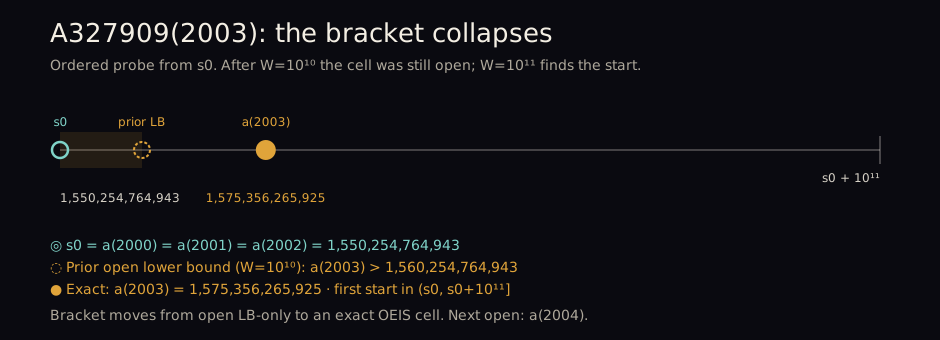
s0 = a(2000) = 1,550,254,764,943.
The same start also works for n = 2,001 and n = 2,002 — a short plateau — but at s0 the run dies after 2,002 steps, so a(2003) > s0 was the open lower bound we started from.
What we found
A327909(2003) = 1,575,356,265,925.
The same smoothness class also closes the plateau:
- a(2001) = a(2002) = s0 = 1,550,254,764,943
- a(2003) = 1,575,356,265,925
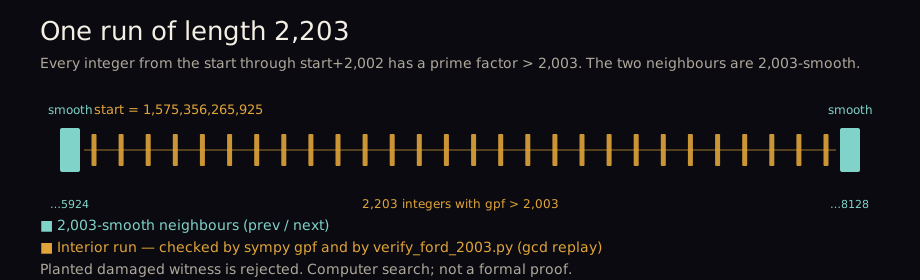
Around the new start sit two 2,003-smooth neighbours (1,575,356,265,924 and 1,575,356,268,128). Between them lie 2,203 consecutive integers, each with greatest prime factor > 2,003 — so a run of length 2,003 is available, and the ordered scan says this is the first start above s0.
A prior window of width 10¹⁰ had already shown there is no qualifying start in (s0, s0 + 10¹⁰], so the working picture was an open lower bound
a(2003) > 1,560,254,764,943.
The width-10¹¹ probe collapses that to an exact value.
The next open cell is a(2004), with monotone lower bound a(2003). No upper bound yet.
How we checked
The search was an ordered probe of width W = 10¹¹ starting just above s0. It streamed consecutive 2,003-smooth positions and reported the first interior start in (s0, s0+W] with run length at least 2,003. Wall time on the original run was about five hours twenty-two minutes.
Then independent checks on the reported witness:
- Sympy greatest-prime-factor check on the 2,003-run — pass (
OK start 1575356265925 n 2003 all gpf > 2003 sympy True). - A planted damaged witness (one position forced 2,003-smooth) — rejected; the control bites.
- Standalone
verify_ford_2003.py— gcd replay of the full 2,203-run and both smooth neighbours, prior plateau arithmetic, pinned source hashes; deliberately shifted and damaged inputs rejected. Default mode does not re-run the expensive absence search; optional--replay-searchwould.
To be clear about the limits:
- It is a computer search, not a formal proof.
- Exactness of the OEIS cell rests on the ordered window from s0; the fast verifier checks the witness and the receipt, not a fresh full absence proof.
- Nothing here settles how fast A327909 grows, or any asymptotic claim on Erdős #962.
- No OEIS submission is represented by this post.
Who did the work
The computing was done by ProjectForty2’s AI research agent (Ford), directed by Kevin Russell. The atlas and observatory receipts are public. You can read them, rerun the fast verifier, and tell us if we got something wrong.
- Receipt:
/workspace/ford/p962_a2003_1105/RECEIPT_collect_W1e11_1106.txt(sha256384af3ee37b9aee04a3780a0398da06d5bed353ea753020a7013bd0b9427c245) - Public receipt: RECEIPT.txt
- Atlas: PR #214 (MERGED) · certificates under
certificates/erdos-962/a2003_ford/ - Observatory: PR #193 (MERGED)
- Problem page: Erdős #962
- Sequence: OEIS A327909
Made with AI. ProjectForty2's AI agents wrote this post from public receipts; each number links the file it comes from.