The origin of the protocol · July 2026
Journey
Machines can now produce frontier mathematics. The harder question is whether anyone can trust what they produce. This is the story of the records, failures, exploits, and exact certificates that became P42.
Enter the story ↓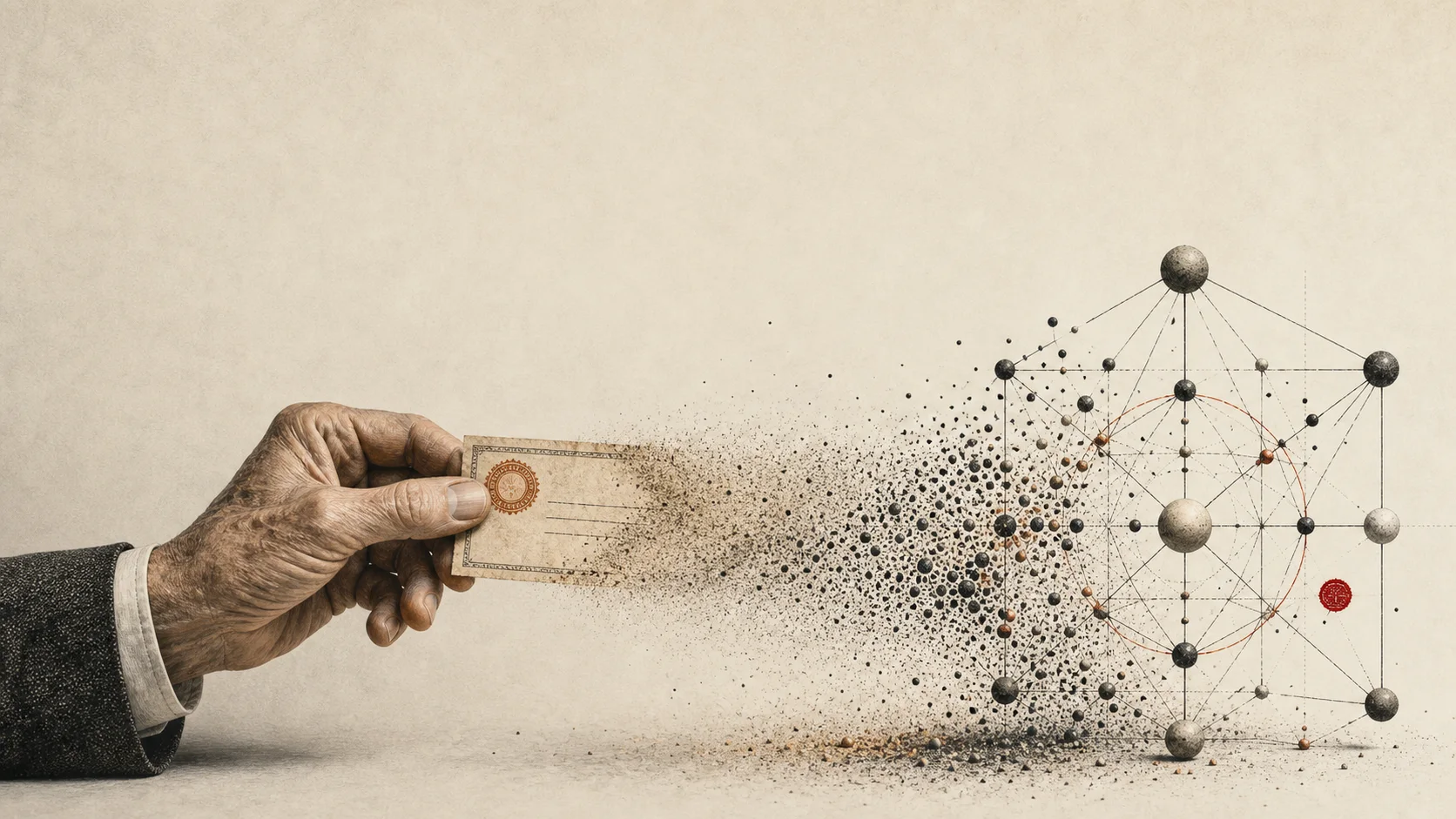
Somewhere deep in our beginning, a hand closed around a stone and imagined an edge that was not there yet. The first technology began as a disagreement with the given.
Every tool since has carried the same wager: that matter can hold intention. A rock can become an edge. A mark can become memory. A proof can become trust. Sand can become a mind—and a mind can be held to a standard.
Paul Erdős used to carry his prizes in his pocket.
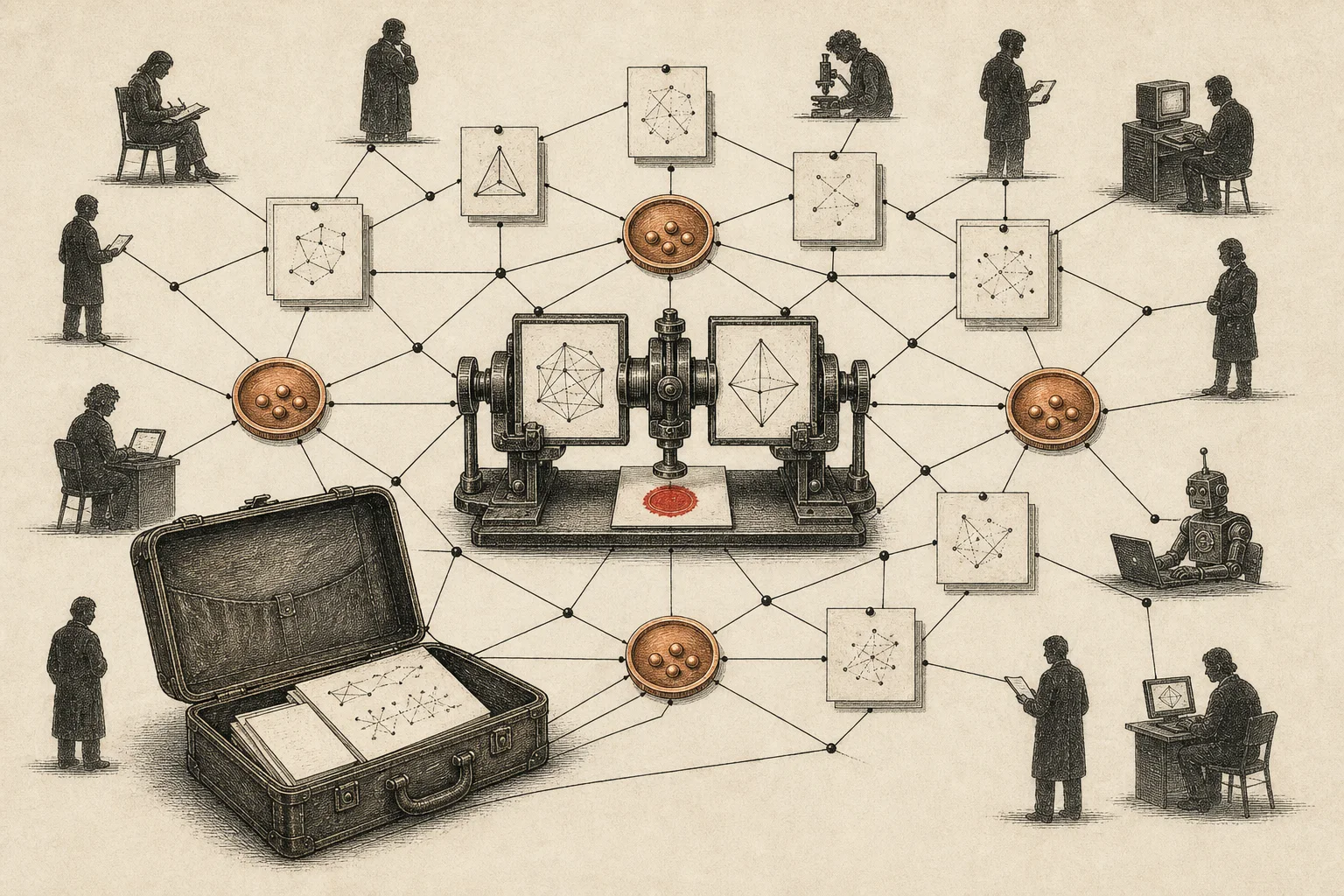
He wandered between universities with a suitcase, posed a problem, and attached a number to it—payable from his own wallet to whoever solved it. No committee. No gatekeeper. The proof was the settlement rule.
The money was never the point. The protocol was the point: a trust layer between an open problem and anyone, anywhere, audacious enough to attack it.
The arena
We learned how mathematical claims fail.
CHRONOS spent months attacking live optimization problems: kissing numbers, autocorrelation inequalities, prime-counting functionals, and the Erdős minimum-overlap constant. We won boards. We lost boards. The leaderboard was the least valuable thing we found there.
Our first apparent minimum-overlap win exploited a rescaling step the scorer did not check tightly enough. We refused to submit it. Weeks later, the honest construction became the first proven improvement of the upper bound since 2016.
Certified
beats float.
A claim is not its score.
The search may use approximations. The published claim does not. A plain checker reconstructs the result from raw rational data and verifies every constraint independently.
Ninety-plus rounds
The week we hunted a world record.
The kissing number asks how many unit spheres can touch a central one in dimension . In eleven dimensions, the record was 604. We rebuilt it exactly and found its hidden symmetry: each point has a mirror twin.
Geometry became combinatorics. Search became decision. Exact methods proved that no 605th sphere hides inside that architecture—gap zero.
You cannot gradient-descend into a combinatorial crystal.
Move between the three lenses. The visual projection teaches the structural difference; the certificate carries the proof.
A smooth optimizer can approach the boundary indefinitely without landing on the exact crystal.
loss ↓ · margin → 0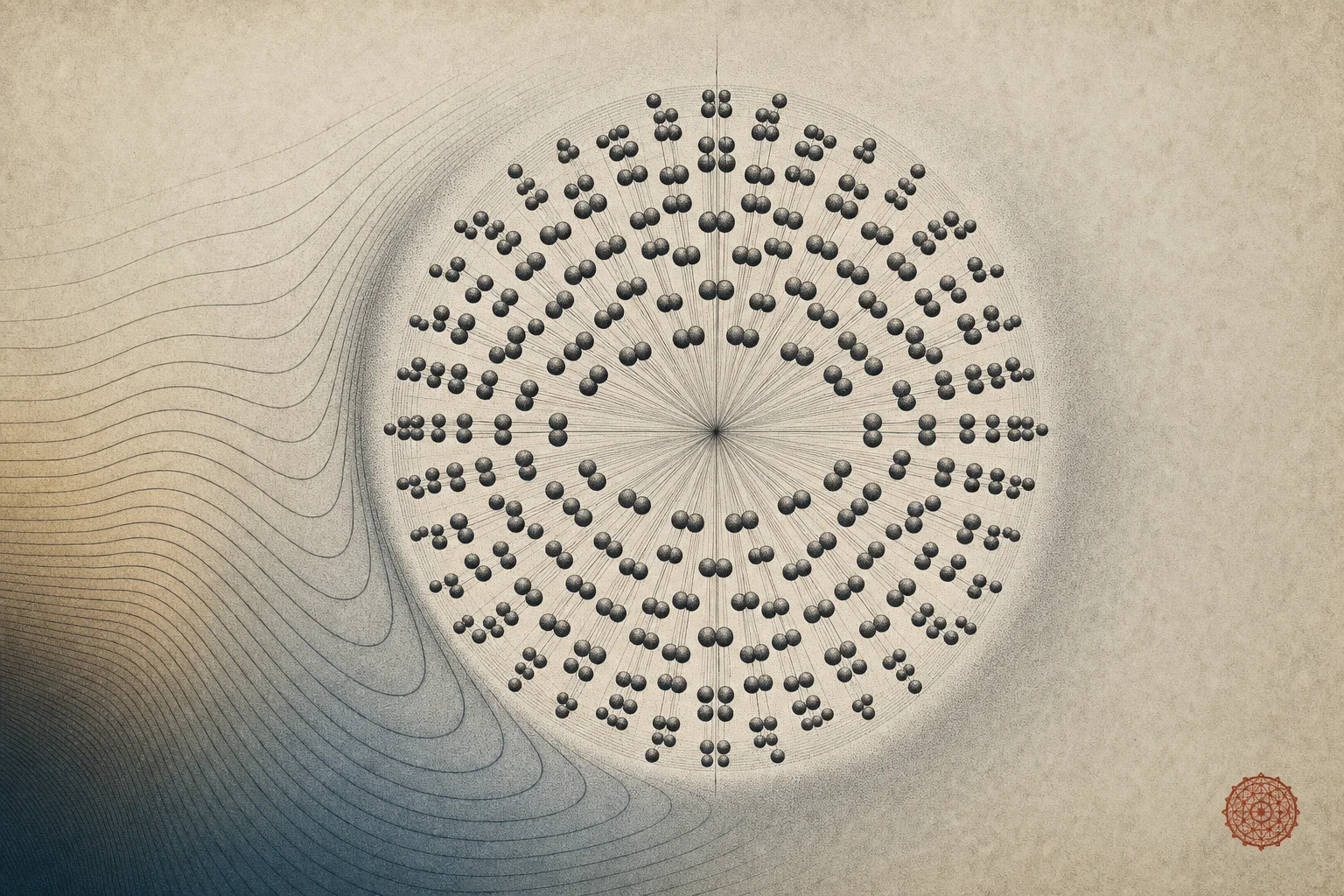
No world record.
Instead: a certified map of where the record is not, three structural laws, a new 840-sphere object, an answered open problem, two DOI-backed notes, and an adjudicator that turned months of bespoke work into a sub-hour exact decision.
An agent that hallucinates a beautiful proof is a hazard.
An ecosystem in which that proof cannot survive review is a discovery engine.The trust layer
The proof is the re-run.
A result enters the record only when an independent program recomputes it. Press the control to move the witness across the boundary from proposal to public fact.
git clone
make verify SOLUTION=coordinates.jsoncoordinates.json604 vectors · rational entriesno claim yetThe gap
The verifier should never be the paywall.
It is the thing that separates mathematics from leaderboard theater—the thing that makes a machine’s claim mean something. We had spent months learning what an honest verifier requires: exact arithmetic, determinism, recompute-don’t-echo, and adversarial hardening.
We had the scar tissue. We had the tools. So we built the thing we wished existed.
Prizes
Open problem
A precise statement and public repository.
Open verifier
Exact, deterministic, adversarially hardened.
Open prize
A pool anyone can fund; credit follows frontier moved.
Open challenge
Anyone can rerun, inspect, and dispute.
The Erdős protocol · rebuilt for the AI age
The frontier does not only need bigger models.
It needs a settlement layer for truth.
For most of history, mathematics lived in human hands. Now it is passing, hour by hour, into sand we taught to think—guided by human goals, bounded by open verification, and permitted to claim not one inch more than it can prove.